Why World Become Global Village
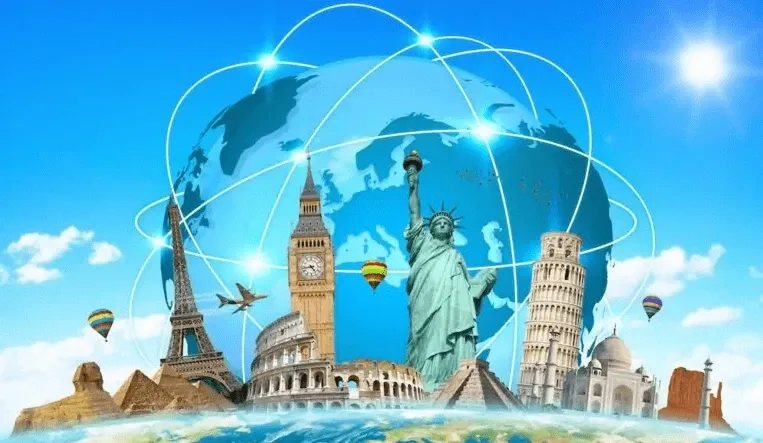
In just a few decades, the world’s distances have shrunk—not because the Earth got smaller, but because our technologies and systems of exchange have accelerated human connection. What once took months to traverse now takes hours. Ideas, conflicts, culture, and commerce flow rapidly across continents. A war in Eastern Europe, for instance, can rattle markets in Asia.
This is what is often meant by the “global village”—a metaphorical space of closeness and interdependence. But how did we arrive here? And what does it mean today?
The Origins: McLuhan and the Media Lens
A Canadian philosopher, Marshall McLuhan, who studies Media Theory, first time the term Global Village in his book. People are interconnected through the Media all over the World. That was not true four to five decades ago. At that time, there was no sign of Smartphones and the Internet.
“Global Village” — First Use
The term “global village” was first used by media scholar Marshall McLuhan to describe how electronic media (radio, television) would draw distant people closer, collapsing time and space in communication. His argument was that media technologies reshape how we perceive the world—turning the planet into a small village in which everything is visible.
McLuhan’s Four Ages of Human Communication
McLuhan framed human history into four ages:
- Acoustic Age – Oral traditions, no writing
- Literary Age – Emergence of writing, alphabet, literacy
- Print Age – Mass distribution of printed text (books, newspapers)
- Electronic Age – Instant communication via radio, television, telegraph, and telephone
He believed the Electronic Age would usher in a new, more intimately connected world—foreshadowing (though not foreseeing) the Internet era.
Even though McLuhan didn’t predict the Internet explicitly, his logic about how media compresses space and time rings true today.
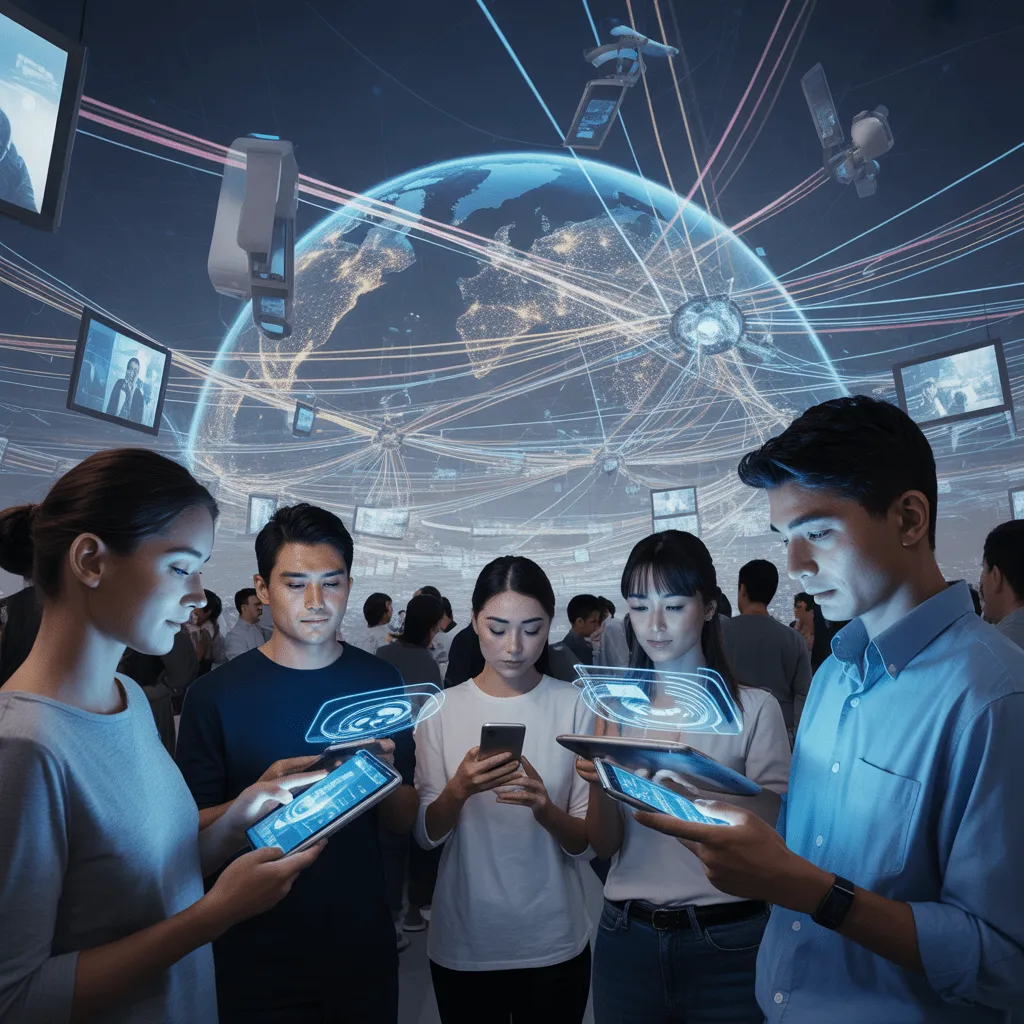
The internet, in particular, has revolutionized communication, enabling real-time interactions, information sharing, and the formation of global social groups.
From Messengers to Instant Messaging
- In the past, messages could only go as fast as ships, horses, or runners.
- With print, news spread via newspapers and telegraphs.
- With radio and television, events in one place were broadcast in another almost instantly.
- Today, social media, messaging apps, and live video calls make “face-to-face” across continents possible in real time.
In short, each leap in communication technology has pushed us closer to the ideal of the “global village.”
The Digital Revolution: Key Enablers of the Global Village
Here’s how modern tech has accelerated our global connectedness:
1. The Internet — Uniting Minds
- As of early 2025, about 5.56 billion people (≈ 67.9 % of the global population) use the Internet. DataReportal – Global Digital Insights
- Some sources estimate around 5.64–5.65 billion users (~68.7 %) globally. World Population Review
- Yet 2.6+ billion people remain offline, mostly from rural and less-developed regions. World Population Review
The Internet has become not just a communication tool, but a market, a forum, a learning platform, and a place for social living.
2. Telecommunications, Fiber, and Satellite Links
Massive undersea fiber-optic cables, satellite constellations, and wireless networks carry data across continents at near-light speed. They make high-definition video calls, streaming, cloud services, and global collaboration feasible.
3. Mobile & Social Devices
- In 2025, over 96.3 % of Internet users access via mobile phones. Exploding Topics
- ~64 % of web traffic now comes from mobile devices. Exploding Topics
- Social platforms like Facebook, Instagram, X (formerly Twitter), TikTok, WhatsApp, WeChat, and others act as global forums for personal, business, and political exchange.
These platforms also amplify cross-cultural visibility—people can share their lives, traditions, ideas, and grievances with global audiences.
Beyond Technology: Forces Amplifying the Global Village
Technology is crucial, but globalization is multidimensional. These forces deepen interconnection:
1. Economic Interdependence
Global supply chains, multinational corporations, and international finance mean that no major country operates in isolation. A factory in Vietnam may assemble parts made in China, with software developed in the U.S., for markets in Europe.
2. Cultural Exchange & Soft Power
Movies, music, cuisine, fashion, and literature now cross national boundaries routinely. You can binge K-dramas in Brazil, eat sushi in Nigeria, or listen to African Afrobeats in Korea. This cross-pollination expands our sense of a shared global culture.
3. Shared Global Challenges & Politics
Issues like climate change, pandemics, migration, and terrorism transcend borders. They force nations into cooperation—or conflict. For example, the COVID-19 pandemic underlined how a virus in one part of the world can ripple everywhere.
International institutions (like the United Nations, the World Bank, and the WTO) and alliances exist to manage such issues. But their effectiveness is often challenged by national agendas and geopolitical tensions.
Pros & Cons of the Global Village
Pros
- Instant Communication across geographies
- Access to Information at one’s fingertips
- Economic Opportunities in Global Markets
- Cultural Enrichment via exchange
- Scientific Collaboration across borders
- Faster Humanitarian & Disaster Response
Cons / Challenges
- Digital Divide: Unequal access remains a major barrier
- Surveillance & Privacy: Governments and corporations collect massive amounts of data
- Cybersecurity Threats: Hacking, misinformation, digital warfare
- Cultural Homogenization: Local languages and traditions may fade
- Economic Inequalities: Some nations or groups benefit more than others
- Geopolitical Fragmentation / Deglobalization: Rising protectionism and trade wars
“Globalization is alive and well,” argue recent studies, though not without new complexities and constraints.
The World Risks Report 2025 warns of escalating geopolitical, environmental, technological, and societal challenges that could strain global cooperation.
New Developments & Tensions in 2025
To keep your article fresh, here are some themes and data from recent years:
- Fragmentation & Protectionism: Supply chains are being reshaped by “friendshoring” (prioritizing allied nations) and defense of national interests. Investopedia
- Geopolitical Barriers to Global Trade: A recent study suggests deteriorating geopolitical relationships have knocked off ~7 percentage points from global trade between 1995–2020. arXiv
- Resilient Trade: Despite tensions, global trade flows remain robust, adapting through regional blocs and digital trade. Wikipedia
- Digital Inclusion & Psychology of Global Identity: A study from Oxford shows that the idea of shared biological life can boost feelings of global unity and motivate collective action on global issues. University of Oxford
The global village concept has increased awareness about environmental issues. People can see and understand how environmental problems in one part of the world can impact others, leading to greater coop
World Learning Global Village
The world, as a global village, is learning to live together. Globalization has led to economic political and socio-cultural integration making the world a global village. The prospects of learning to live together are however still evolving but hurdles persist. rsist. Globalization of the economy, integration of politics, socio-cultural integration, contemporary manifestations of learning to live together in the global village.
Strengthening Of the Global Village
Strengthening the global institutions. Minimizing the ideological difference between civilizations, pursuing a mutual interest, common trends liberalism of trade, and dialogue to be the first choice of conflict resolution and then conclusion. The world is called a global village by virtue of globalization, which is a multifaceted process. Government Of The Global Village

Product investment, investments, profits, and political terms for global villages. These are featured by the presence of an evolved international community on the platform of the United Nations. The global village economic integration has brought the world closer and more dependable on each other.
Political integration of the world states helps to unite the global village and becomes obvious at the platform of the united nation. Now, the United Nations has 193 member states that discuss and decide upon all the important political events of international prospects.
International political security, regional and global alliances against terrorism, international treaties, and nuclear non-proliferation all reveal the political integration of the global village.
Nations And Globalizations
Globalization is the integration of everything. It can be an integration of political, cultural, and technological prospects. The most important manifestation of globalization is economic and political integration. Multinational companies and global institutions represent how the world is learning to live together.
European Union, for example, represents the togetherness of the European nations. Similarly, ASEAN is the association of Southeast Asian nations. To attain definite economic goals, South Asia emerged to be an organization for regional cooperation. OIC represents the Muslim states of the world as their distinct body.
The Organization of Islamic Cooperation is the second-largest intergovernmental organization in the Global Village, after the United Nations. It represents the collective voice of Muslims in the world. OIC goals are centered around creating Muslim solidarity and protecting Islamic holy sites. They help Palestinian causes, improve the economy, and end racial discrimination.
It reflects how the nations are learning to live together.
Conclusion & Forward Look
The global village is not a static destination—it’s a dynamic, evolving space shaped by technology, politics, culture, and human choices. Over the past decades, we’ve moved from distant nations to a nearly seamless world of trade, communication, and shared challenges.
However, the path forward is contested:
- Will we deepen inclusion, digital equity, and cooperative governance?
- Or will rising nationalism, fragmentation, and inequality pull us apart?
- The future of the global village depends less on technology now—more on how societies choose to use it.


2 thoughts on “Why World Become Global Village”